



Foundation in Numbers
helping young scientists fulfill their scientific dreams
young scientists have launched their careers at prestigious universities abroad thanks to our support
starting grants awarded to young scientists, helping them set up their own research groups in the Czech Republic
chemistry centres at the University of Chemistry and Technology in Prague, where teachers learn how to make chemistry cool
schoolteachers have been able to make chemistry lessons more exciting thanks to our Cool Chemistry grants
winners of the prestigious Rudolf Lukeš Prize for excellent senior chemists
winners of the Via Chimica Prize for young university chemistry students
CZK allocated to date to support Czech chemistry
The Story of the Dvořáks
“We return money to whence it came – science,” say the Dvořáks
Hana and Dalimil Dvořák, the couple who established the Experientia Foundation, met each other during their student days, and it is entirely symbolic that they met in a chemistry laboratory. While Hana Dvořáková (HD) subsequently went on to collaborate with Professor Antonín Holý at the Institute of Organic Chemistry and Biochemistry (IOCB) on the development of antiviral compounds, Dalimil Dvořák (DD) became a professor at the University of Chemistry and Technology (UCT) in Prague. In 2012, they started the Experientia Foundation, which supports young scientists in the fields of organic, bioorganic, and medicinal chemistry and, to date, they have provided grants to dozens of young scholars to help fund their post–doctoral research stays abroad and using starting grants they motivated several more young scientists to establish their own research groups in the Czech Republic. The Dvořáks unhesitatingly devoted more than a quarter of a billion CZK they have received from the licensing royalties associated with the antiviral compounds developed at the Institute of Organic Chemistry and Biochemistry in Prague (IOCB) back to science, explaining that this is, after all, whence the money comes.
I would like to start by finding out more about your reminiscences about Professor Holý, as, essentially, that is where the story of the Experientia Foundation begins…
HD: Yes. Although we established the Experientia Foundation only in 2012, its story actually dates back to 1986. Back then, I was employed at IOCB at the Department of Nucleic Acid Chemistry, but I wasn’t very satisfied there and I announced that I would like to leave. Ivan Rosenberg, who was Antonín Holý’s closest collaborator at that time, proposed that I apply for a position in Holý’s working group, as he had just been given his own laboratory. So I actually went to Professor Holý and quite openly asked him: “May I work with you?”, and Professor Holý said: “Yes.“ Whenever I later recounted this story to anyone, they were all surprised. Particularly my mother, who asked me: “You really just went up to him and asked?”
What were your first impressions when you first started collaborating with Professor Holý?
HD: Things were very good right from the start; the environment was highly motivating and I enjoyed it enormously. At the same time, collaboration with Professor Holý was very specific in many ways. For example, when he assigned me my first tasks, I was looking for a place to sit down so that I could write up my protocol. Professor Holý told me that I didn’t need a chair. He also said that I should plan my work in such a way that, when one chemical reaction is underway, I should use the time to process the results of the previous one. This was of course a good idea and led to great effectivity, but because the working up of the reaction is usually much more time-consuming than initiating it, my work in Holý’s laboratory was very demanding and stressful.
Which part of the research did Professor Holý place in your hands at that time?
HD: Professor Holý gave me the task of preparing a series of 3-deaza acyclic analogues of nucleosides and nucleotides (the nitrogen in position 3 was substituted with carbon on a heterocyclic basis). This concerned the further modification of acyclic analogues with a unique structure and with very promising antiviral effects, which Professor Holý had recently prepared in collaboration with Ivan Rosenberg. Back then, Professor Holý told me: “It’s a challenge!” At that time, I didn’t yet know exactly what he meant, but I soon found out. The synthesis of 3-deaza analogues of acyclic nucleoside and nucleotide analogues also became the topic of my dissertation, something Professor Holý talked me into during the very early days. I originally wasn’t planning on getting a PhD at all, as I didn’t have much faith in myself and was convinced that I didn’t have sufficient skills for scientific research. In addition, I already had two small children and, as a result, I had the feeling that I didn’t have enough time for science. But Professor Holý ultimately convinced me otherwise.
Were you, at the time, aware of the breakthrough nature of your work?
HD: Of course I knew that I was working on the development of new antiviral compounds. The group of compounds on which we were working did indeed consequently become the basis for a new generation of antiviral drugs. The first of these was Duviragel, which is active against herpes viruses. Others worth mentioning include Vistide, which is used to treat cytomegalovirus retinitis, and Hepsera, which is used in the treatment of chronic Type B viral hepatitis. However, the most important of the compounds from this series is undoubtedly Viread, which continues to be one of the most effective drugs in existence today for the treatment of AIDS. There were many research groups working on modifying nucleoside and nucleotide analogues at that time, but it was Professor Holý who had the good fortune that specifically his modifications were effective.
How did Professor Holý successfully introduce his effective compounds into practice?
HD: Professor Holý had prepared the majority of the most important compounds even prior to 1989, that is to say, at a time when it wasn’t possible to move the research forward in Czechoslovakia in a direction that would lead to the introduction of a compound prepared in a laboratory into practice. This is a very time-consuming task and, above all, an extremely expensive process. Compounds are first tested on cell cultures. The next step involves intensive testing on animals. Subsequently, it is only during the next phase that clinical testing can begin. The entire cycle takes about ten years and is indeed very costly. In then-Czechoslovakia, Professor Holý would never have had the opportunity to complete it, not only because of financial limitations but also because there was no political support for his work. Fortunately, during the 1980s and 1990s the regime no longer prevented scientists from participating in international conferences, and it was there that Professor Holý’s noteworthy results captured attention.
And that is how the famous Holy Trinity collaboration came into being?
HD: Yes. Professor Holý actually first met Erik De Clercq from the Catholic University of Leuven in 1976 at a conference in Göttingen. This educational institution was equipped with a world-class laboratory for testing a diverse range of viruses on cell cultures. It was then that a joint research agreement was signed, and, from that time on, all of the compounds prepared in Holý’s laboratory were sent to Belgium for in vitro testing. Ten years later, the results from Holý’s compounds convinced Professor John Martin, an American scientist working for the Connecticut-based Bristol-Meyers pharmaceutical company, that they had great prospects and work on their development was launched there. This trio later started to be called the Holy Trinity. The relevant patents were later purchased by Gilead Sciences, a small pharmaceutical company with fifteen employees, where the further development of antivirals continues to this day. However, the company now has several thousand employees. When I first joined Holý’s group, it was already standard procedure for all compounds to be sent to Belgium for cell culture testing, and it was just at that time that the collaboration with the American side was starting.
Which of the compounds were the Americans interested in?
HD: The Americans were interested in the entire group of nucleotide analogues – so-called acyclic nucleoside phosphonates. These involve a modification where the phosphorus is bonded directly to the carbon, as compared to the phosphates in natural nucleotides, where oxygen is bonded between the phosphorus and the carbon. It is specifically this slight modification that led to a great breakthrough in the treatment of viral diseases, primarily AIDS. Their unique biological characteristics are associated with the significant similarity of their structure with natural nucleotides, as well as with their high stability within an organism.
How were the patents handled?
HD: Professor Holý was not only an outstanding scientist but he was also a clever organiser and had been well-informed by his collaborators from abroad, so that he obtained patents on a regular basis for all of the compounds originating in his laboratory. When the Americans became involved in the research, the patents of course immediately became much more complex and they were also written up much better.
Professor Holý had an incredible number of patents. How did this come to be?
HD: The number of preparations that came from his laboratory is absolutely unique, but, at the same time, he never had a large group. During the years I collaborated with him, his group also included an excellent laboratory technician – Běla Nováková. It was particularly because of Běla that Professor Holý would often declare that a qualified laboratory technician is much more valuable to him than “some engineer”. The synthetic processes that led to the discovery of the most significant active substances were not all that demanding from the perspective of instruments, but it needs to be stressed that, for the most part, Professor Holý prepared them himself thanks to his extreme diligence, knowledge, perseverance, and enthusiasm. Of course, he also had a lot of luck, first with the modifications based on sugars, but mainly with the modifications based on phosphorus. In his case, the old adage “luck favours the well-prepared” applied 100%.
How did you feel when you found out that you would receive a share of the licensing royalties for the antiviral drugs?
HD: It all started very inconspicuously. At first, I started receiving the licensing royalties for the antiherpetic drugs. Even though these were small amounts, we thought it was fantastic. As two young scientific workers with below-average wages and with two young children, we couldn’t even afford our own housing and lived with our parents. Paradoxically, the licensing royalties started to arrive when I was no longer working for Professor Holý. One day – this was after 2000 – he invited me to come see him and told me: “Hana, you’ll be able to buy something bigger now. Maybe a flat!” And this truly happened. We soon started receiving higher amounts in our bank account from the licensing royalties for Viread. When someone has so much money all of a sudden and isn’t used to spending much, they really don’t know what to do with it. Before then, we were happy we could even survive, and now we were getting more money every month.
When did you decided you would be philanthropists?
HD: I was well aware that having money is a great responsibility and that I must make a good decision about how to use it. I had visions of our money helping the sick, the disabled, the poor, people in dire straits, and so forth, but then I realised that there wouldn’t be enough money to help all of the needy. I had no clue where to start. In 2002, the year of the devastating floods, I was shocked by the situation in the afflicted areas. After seeing a news report on Czech Television about how the People in Need organisation was helping those severely affected in Northern Bohemia, it suddenly dawned on me that I also wanted to help them. It was a spur of the moment impulse; I looked up People in Need’s bank account number on their website and immediately sent them a million crowns. This was our first philanthropic act and we felt good about it. Šimon Pánek (editor’s note: the director of People in Need) invited us so he could thank us, and this marked the start of our close working relationship with this wonderful non-profit organisation. Over the fifteen years of our cooperation, it became clear to us that we chiefly want to support the education of socially marginalised children, as this is an area which remains quite neglected by the state and even private investors are reluctant to invest in it.
How is it that you did not stay with this particular good deed?
HD: We knew that there would be even more money and that we have an even greater potential. Then one day, in the supplement to the Hospodářsky noviny daily, I read an interview with Tony Meyers, an acknowledged Canadian expert on the subject of philanthropy. He talked about how he works with philanthropists. I suddenly got the idea that I’d like to speak with him, and that I would like to know how best to direct the money. The Via Foundation, which had invited Meyers to Prague, arranged a meeting with him for me. The result of the inspiring discussion I had with Tony was mainly finding out about his experience with looking for the right philanthropic project, that it’s usually a long process requiring a lot of effort. Tony also introduced us to Jiří Bárta, the former director of the Via Foundation, which is another organisation we have been helping to support since then. Chiefly, however, we have been able to polish our philanthropic opinions with the people behind the Via Foundation, which has greatly helped us in building our own foundation.
You have donated more than a quarter of a billion of your share of the licensing royalties for antiviral drugs to your own Experientia Foundation. How did you decide that you would use the money in this specific way?
DD: In 2012, we went to Milan with some friends – former colleagues from the IOCB – to see the sights and enjoy good Italian food and wine. We had a lot of time for discussing a broad range of topics, and one of them was the not–very–optimistic situation with regard to Czech science. In relation to this, it was mentioned that it’s a shame that Professor Holý, who was receiving the largest share of the licensing royalties at the time, doesn’t use this money to support our young scientists.HD: During the flight home from Milan, I got the idea that we could actually do this. As soon as we arrived in Prague, I told Dalimil and he replied: “I had the same thought.”. But that is how everything works with us.
So you decided to donate your money to science, specifically to the field of research whence they come…
DD: This line of thought was clear from the very beginning. We said that we’d return the money to whence it came – meaning organic, bioorganic, and medicinal chemistry.
What was your vision when you were in the process of establishing the Experientia Foundation?
DD: We knew that we wanted to support young chemists after they receive their PhD. Scholarships awarded to students for study stays abroad were fairly common, but there were practically no programmes that offer anything comparable to those who have completed a doctorate in the Czech Republic. Meanwhile when someone is applying for a good position abroad and says that they have their own source of financing, they have a definite edge over other candidates. And so we decided to give our grant recipients this advantage.
How did you, as two chemists, come to terms with dealing with the various administrative difficulties associated with running a foundation?
HD: We were honestly terrified of the organisational aspects, but we have excellent colleagues to work with us. Thanks to them, we were amazed to discover that all of the administrative and organisational tasks can be completed very smoothly. Our association with the IOCB, where the Experientia Foundation has its headquarters, also helped. This connection is completely logical, as it was at theInstitute that Professor Holý carried out his research. We were grateful to Zdeněk Havlas, the former director of the Institute, for supporting our foundation in this way. Other IOCB directors are also very supportive and support us in any way they can.
Every year, the number of individuals applying for your grant exceeds the number of scholars you ultimately send abroad. How are the submitted projects assessed?
DD: We work together with a number of experts from the fields of organic, bioorganic, and medicinal chemistry who evaluate the projects. After we receive their evaluations, we work with the Grants Committee to select the applicants who will move on to the second round. During this process, they have the opportunity to present their project to us in person. Based on the expertise and the Grant Committe’s evaluation, we decide which of the candidates will receive a grant in the given year. Thus far, we have always reached an absolute consensus.
What was it about those scholars who have received grants that captured your interest?
DD: There is absolutely nothing personal involved, as we assess the candidates on the basis of their projects. When we first started, we met with our colleagues from the Hlávka Foundation. They advised us that the description of the materials that are to be submitted with the application should not be overly specific. The way in which a candidate writes their cover letter, their CV, and their project actually says much about them – about their approach to work, and how methodological and systematic they are. This advice continues to greatly help us with our selection of grant recipients.
Can you describe, in general terms, what a scientist must fulfil in order to receive a grant?
DD: What we value the most is if the scientist has a truly original and ambitious project that has nothing in common with their previous focus. There have been cases where we had to decide whether to provide support to a candidate interested in working in a prominent laboratory or to someone who wanted to work in a laboratory run by a young professor. The project of the latter candidate was so interesting and appealed to us to such an extent that we ultimately awarded the grant to them, even though there was a higher degree of associated risk. Of course, in addition to the quality of the project itself, it also depends on whom the young scientist will be working with and, no less importantly, their previous success. I must say that the majority of submitted projects are very good and we feel that the quality of applications is higher every year.
To date, dozens of scholars have been able to work abroad thanks to your support. What gives you the greatest pleasure? What are you most proud of?
DD: Our scholars have already published quite a large volume of materials, all in very well-known journals, including Nature. For example, our very first scholar, Jakub Hývl, asserted himself with the work he carried out under the Nobel Laureate Professor Richard Schrock, who ultimately offered him the ability to stay on for a further year out of his own resources. This is wonderful proof of the fact that the money expended for his grant was in truly good hands.
Today, Jakub is continuing his career and to our great joy others are following him, starting research groups and changing the future of Czech organic chemistry. We are very happy that all of our scholarship holders are spreading the good name of Czech chemistry but also of the Czech Republic as a whole, and this is very important to us.
But you support Czech science even more. You have launched a programme of starting grants for young scientists to set up their own research groups in the Czech Republic. How did you come up with the idea to initiate another major programme of this scope?
HD: We were trying to think of some other ways in which we could support Czech science even more. We reached the conclusion that it’s necessary to motivate young scientists who have returned from stays abroad in such a way that they will be able to establish their own research groups in the Czech Republic. In our opinion, this is a crucial point in their careers. They do well abroad and have enough money there, but it’s impossible to remain on a post–doctoral stay forever. Quite often, they already have their own families and are wondering whether they want their children to be American or Czech. They long to return to the Czech Republic but don’t know what they would do here – there is no funding for scientists who are just starting out, and finding a place in the existing structures is very difficult… And so we came up with the idea of starting grants for scientists just launching their career in organic, bioorganic, or medicinal chemistry, who have completed at least a year–long research stay abroad and who would like to establish their own research group in the Czech Republic.
Why do you support new research groups and not the existing ones?
DD: We want to take advantage of the experiences young scientists have gained abroad to support new, innovative projects. Only in this way will science move forward. We don’t want to provide support to people who continue to work on the same subject they focused on during the entire course of their studies, that is to say the subject their research supervisor was focused on (so-called “inbreeding”).
In the rules of the Starting Grants you mention new and risky topics. In what sense should a project be risky?
DD: The projects should be ambitious, they should not repeat or expand on something that is already known from literature. Every such project is then naturally risky to a certain extent. Another important aspect is the timeframe of three years, which is the period of time during which we will help support the research group. We expect that the principal investigator will have a more long-term vision and will strive to receive an ERC grant (editor’s note: European Research Council grants are awarded by the European Commission).
For your Starting Grant programme, you collaborate with Czech workplaces that provide an environment for research groups. What does cooperation with them look like?
DD: We are delighted that research groups supported by the Experientia Foundation Starting Grant have already been established across the Czech Republic at the Science Faculty of the Charles University in Prague, at the University of Chemistry and Technology in Prague, at the Faculty of Science at Palacký University in Olomouc and at the Faculty of Science at Masaryk University in Brno. At all these institutions, the cooperation is flawless and it would be our wish to see the starting grants expand to other Czech universities.
You have already awarded a number of Starting Grants, are you satisfied with the young research groups? Are they succeeding in fulfilling your vision?
HD: They most certainly are. It turned out that the vision, for which it was worth investing the largest amount of foundation funds into this programme, was the right one. The starting grants have a far bigger reach than our programme for research stays abroad, as the research groups are here in the Czech Republic for significantly longer than the three years we support them financially. Today, several years later, we are already seeing other young scientists and other successes of Czech science being added to these research groups and that we are truly shaping the future of organic and medicinal chemistry in our country.
But you didn’t stop at two programs…
Yes, our programs have expanded over time. In addition to the international research stays program and the starting grants, which we consider our two flagship programs, we also support chemistry teachers in primary and secondary schools through our programme Cool Chemistry so that they can get better equipment for their labs and make chemistry more attractive as a subject. We also support an excellent program of the University of Chemistry and Technology in Prague, where Teachers Teach Teachers how to teach chemistry in a different, fun way. This programme has a huge impact, with around 300 teachers a year participating, which is a really high number already. We also contribute to the awards programs for undergraduate students (the Via Chimica Prize) and senior scientists (the Rudolf Lukeš Prize).
There really is a lot. What is your main goal today?
The Experientia Foundation’s main goal is to provide the best possible support to up-and-coming young chemists, giving them the opportunity to apply their discoveries, whether they are developing new medicines, inventing new energy sources, or coming up with more environmentally friendly technologies.
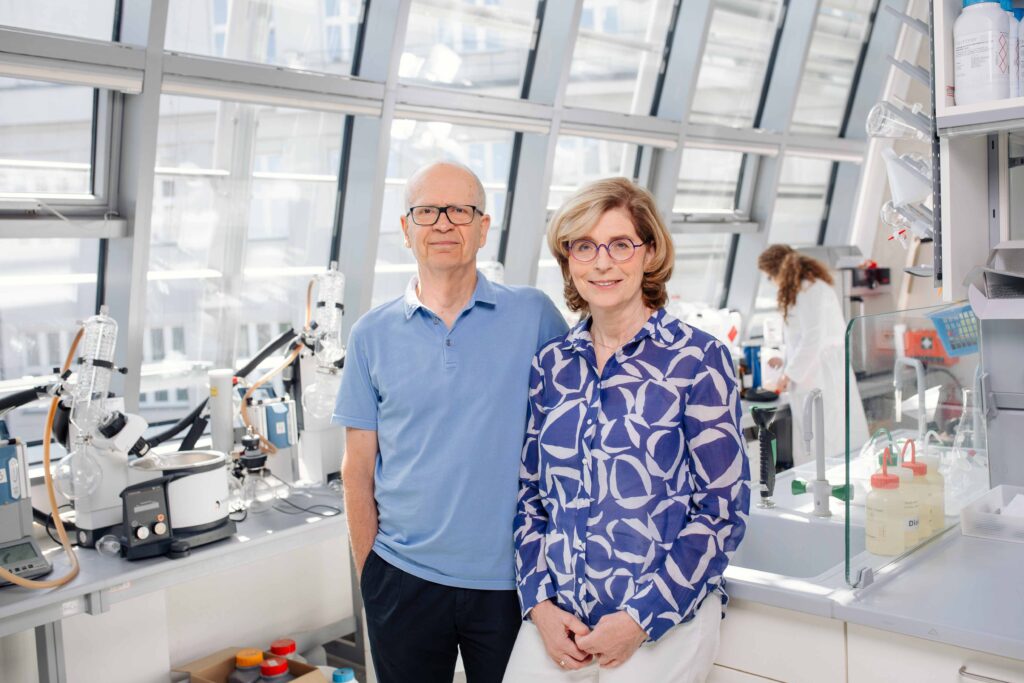
Hana a Dalimil Dvořák
Hana and Dalimil Dvořák, the founders of the Experientia Foundation, are prominent Czech scientists and philanthropists. Between 1986 and 1996, Hana Dvořáková worked with Professor Antonín Holý at the Institute of Organic Chemistry and Biochemistry of the Czech Academy of Sciences on the development of antiviral compounds that would become the basis of future AIDS medications, contributing to one of the major discoveries of Czech science. Dalimil Dvořák is a professor at the University of Chemistry and Technology in Prague. Together the couple have donated more than 250 million CZK to their foundation in support of Czech chemistry. They also support the People in Need Foundation, the Via Foundation, and the Czech Philharmonic.
Shaping Czech Philanthropy
Text: Hana Dvořáková, editor: Anna Slaninová
When my husband Dalimil and I first set up the Experientia Foundation, our aim was “merely” to support young scientists at a crucial early stage of their careers, and in doing so, to help push Czech chemistry closer to the global forefront. We had no idea that journalists would one day describe our philanthropic venture as heralding a new era of Czech philanthropy, or that other foundations would consider us a kind of model to follow. But since things turned out that way, we realised it was time to tell our story in full, for the benefit of future philanthropists and for colleagues across the non-profit sector. It is a story that spans from our modest beginnings as a “pass-through” foundation to today’s confident institution funded by its own endowment. We came to realise that our actions might not only influence the field of chemistry itself but perhaps also contribute to refining Czech society’s understanding of the vital role of philanthropy. The Experientia Foundation shows that modern foundations need not be mere providers of ad hoc support, but that they can become robust institutions with the ambition to change the world in the long term.
Chapter 1: A “Pass-Through“ Foundation (2012–2019)
We established the Experientia Foundation at the end of 2012 in a rather improvised fashion. As two scientists, we had no experience with running a foundation and no real understanding of what it involved. We only knew that we wanted to use the funds we had earned from licensing revenues for antiviral compounds developed at the Institute of Organic Chemistry and Biochemistry (IOCB) of the Czech Academy of Sciences to support young Czech researchers in organic and medicinal chemistry at the start of their careers. We invited only a few close colleagues (also scientists) to join us, and in retrospect our early steps appear rather amusingly naive.
In those days the foundation operated much like an on-demand water heater: whenever we selected new fellowship recipients, my husband and I would wire the money for their international research stays straight from our kitchen in Spořilov in Prague. It now sounds hard to believe, but this is genuinely how we operated for several years – years in which we supported excellent young scientists as they proved themselves at places like MIT and Stanford. Outwardly, everything might have appeared viable, but privately, we felt the system was no longer fit for purpose. The turning point came in 2017, when we found ourselves in a seedy, rather sinister-looking alley in Brooklyn during a trip to the United States. We realised that should anything happen to us, our venerable foundation would disappear before it had even truly begun. That moment sparked serious deliberations about professionalising the foundation.
Chapter 2: “Sunset“ Foundation (2020–2023)
At this point it is worth noting that, beyond science, my husband and I have long been committed to several other philanthropic causes close to our heart: supporting the education of children in socially excluded communities and media education in schools through the People in Need organization; nurturing exceptional young Czech musicians through the Czech Philharmonic Development Foundation; and strengthening civic engagement and community life through the Via Foundation. It was through the Via Foundation – which we have supported for many years – that we were introduced to experts in philanthropy, foundation law, and also financial management. With their guidance, we began exploring ways to professionalize the running of our Experientia Foundation.
The in-depth discussions that followed led us to a major decision: to commit our funds to the foundation irreversibly. The 200 million CZK we donated to support young chemistry talents would allow our programmes to operate for twenty years. But this meant essentially rebuilding the Experientia Foundation from the ground up – this time as a “sunset” foundation (i.e. one designed to deploy the entirety of its resources for its mission within a defined time frame – author’s note) with new leadership, a new governance structure, and an Investment Committee. It took significant effort, but we knew why we were doing it: to ensure that the foundation could function independently of us and have a long-term impact. Only long-term support, we strongly believed, could create lasting change.
When we announced our plans in January 2020, it caused quite a stir. Such a step was unprecedented in the Czech Republic at the time – individuals had not been in the habit of divesting themselves of ownership and control over their assets at this scale for the public good. It was then that journalists began to speak of a new era of Czech philanthropy. Although we were uncomfortable with the media attention, we were delighted to see other philanthropists soon follow suit with even more ambitious ventures – such as the remarkable Katarína and Ondřej Vlček, who contributed 1.5 billion CZK to their Vlček Family Foundation in 2021; and the Wałach brothers, who donated over 1.8 billion CZK to their 3W Foundation in 2022.
However, we were mistaken in thinking our work had ended with our donation and the professionalisation of the foundation. In fact, that is when the real work began. The newly assured Experientia Foundation now had to manage not only its grant programmes and concerns about the future of Czech science, but also its newly sizeable assets. We were extremely fortunate to be able to assemble an Investment Committee with our new colleagues after 2020, one which – as someone later remarked – “many a bank would envy”. Every expert who helped us develop the foundation’s investment strategy did so voluntarily, without remuneration.
Thanks to their work, the Experientia Foundation began standing out in the Czech philanthropic landscape also for the way it invested. A significant portion of the foundation’s assets was allocated to bonds, equities, residential real-estate projects, and industrial companies accessed through private-equity funds. These are investments that offer solid returns but require expertise and time – both of which were fortunately available to us. Two well-established investment firms managed the day-to-day decisions, overseen by our committee of seasoned financial professionals.
It was these investment advisors, the “dream team” of David Borges, Petr Zapletal, Tomáš Suda and Petr Knapp, who proposed a transformative idea: if invested prudently, the 200 million CZK could grow in a way that would allow the foundation not to close after twenty years, but to operate indefinitely for the benefit of talented young scientists – funded solely through returns on its endowment. Unsurprisingly, this idea sounded highly attractive to us as founders, and to everyone involved with the foundation.
Chapter 3: A “Permanent“ Foundation (2023 – ∞)
Could we extend the life of the foundation from the originally intended twenty years to forever? At first, perpetuity seemed unrealistic. But the more we explored our options with experts, the more feasible it appeared. And so, at the end of 2023, we began the third chapter of our story. Following our Investment Committee’s recommendation and inspired by major US foundations, we moved the foundation’s original 200 million CZK into a permanent endowment (capital that remains intact, is invested, and the returns on which alone finance the foundation’s activities. Properly managed, an endowment allows a foundation to operate independently and indefinitely, free from reliance on ongoing donations or grants – author’s note).
According to the investment committee’s projections, a long-term average annual return of around 7% should provide sufficient resources to support young chemistry talents not merely for twenty years but for decades – an extraordinary prospect. To help bring the foundation even closer to true perpetuity, my husband and I donated an additional 50 million CZK to support the foundation’s operating costs and grants. By contributing more than a quarter of a billion CZK of our own funds to the Experientia Foundation, we hoped to signal to other philanthropists what is possible.
It is no secret that the foundation still needs several tens of millions of CZK to reach full endowment sustainability. However, we believe that we will find partners who see things as we do and who will help us ensure the foundation’s goals in perpetuity. And not only that, but we hope that our story will serve as inspiration to the many gifted and talented people in the Czech Republic, in the scientific community and beyond.

What they said about us

“I have the deepest admiration for everything Hanka and Dalimil do. We can only hope that the unique Experientia project will become a model for future generations of philanthropists.”
Ing. Petr Knapp
investiční poradce

“It is rare to even conceive of a vision like that of Hanka and Dalimil, let alone bring it to life. Such acts move society forward for several generations.”
RNDr. Petr Zapletal, MBA

“Hanka and Dalimil’s energy is embodied in this ambitious plan, which will support Czech science for decades – perhaps even forever. It’s a privilege to be part of it.”
Ing. David Borges

“Experientia is like a perpetual test tube from which a whole new generation of future Nobel laureates may emerge. A rare catalyst is the generosity of Hana and Dalimil Dvořák.”
RNDr. JUDr. Tomáš Suda, M.A., M.B.A.
Science Changing the World
We would like to thank Adéla Špaljová (director and editor), Jana Plodková (voiceover), Richard Müller (sound), and Matěj Chovanec (video post-production).